
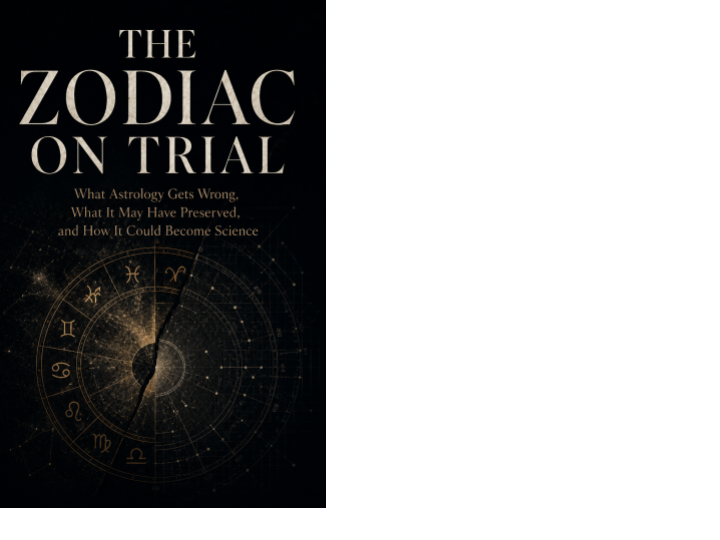
Culture & literary experiment · Axiologic Research Editions
The Zodiac on Trial
A Case for Doubt Without Contempt
Put the zodiac in the witness box without caricaturing it or granting it special immunity. The testimony moves from ancient calendars and biological seasons to personality experiments, self-fulfilling labels, consultation rituals, and AI profiles that may become far more persuasive than any horoscope.
A trial, not a cheap acquittal
The Zodiac on Trial stages a rarer encounter than either a horoscope or a debunking thread. It begins by constructing the strongest defence of an idea many educated readers find embarrassing, then gives the prosecution its full case. Astrology is placed in its older world, where the sky was calendar, government and memory, before the book asks what remains once causal claims meet modern standards of evidence.
The resulting argument is careful about categories. A tradition can be historically important, psychologically resonant and socially causal without correctly describing a physical influence from planets to personality. That distinction lets the book take believers seriously without granting an exemption from testability.
The witness box is open
Why has astrology lasted? The early chapters treat it as a durable symbolic system rather than an intellectual embarrassment to be dismissed. It has offered calendars, collective memory, stories of temperament and a way to turn uncertainty into a readable pattern. Understanding that function is not the same as proving its cosmology.
Does date of birth tell us anything? The book grants a more interesting possibility than star-sign essentialism: birth date can be a compressed variable for season, cohort, school timing, culture and family circumstance. It then distinguishes such mundane correlations from astrological mechanisms. The prosecution’s case addresses failed predictions, vague descriptions and the familiar human ability to recognise itself in almost every mirror.
What happens when AI learns to read us better than a zodiac column? Its final chapters imagine personalised systems that can generate uncannily apt “readings” from behavioural data. That future could reinvent astrology without celestial claims, making the old psychological market for destiny newly powerful. The book proposes experiments, randomised readings, blind conditions and comparisons across knowledge levels, to separate recognition from accuracy.
A false cosmology can still organise real choices; that makes criticism more necessary, not less humane.
After the verdict
This short book is for readers who dislike being forced into two bad roles: credulous participant or contemptuous sceptic. Its strongest contribution is methodological. It shows how to preserve historical and emotional complexity while asking what would count as evidence, what a claim actually predicts and how an experiment could fail.
Personality systems, algorithmic profiling and the market for personalised meaning all become harder to discuss after this trial. The sky may be silent in the scientific sense, the book suggests, yet the zodiac can continue speaking through culture, identity and ever more intimate interfaces. That is precisely why it deserves a serious hearing.