
Social theory · Axiologic Research Editions
The History and Future of Social Technologies
The Yin-Yang of Civilization
Look behind every sword, coin, passport, scientific fact, and digital identity. Each works because an institutional world makes it meaningful. Follow the hidden half of technological history—and confront the coming struggle over the intelligent interfaces that may soon interpret society’s rules on everyone’s behalf.
The invisible half of every invention
We remember the plough, steam engine and computer because they can be displayed. This book asks us to look at what lets any of them enter a shared world: contracts, discipline, education, records, insurance, law, standards and authority. A ship is also credit and admiralty law; a factory is also wage time, accounting and labour organisation; a computer is also protocols, identity and rules for access. Alboaie calls these reproducible arrangements social technologies: configurations of symbols, roles, procedures, incentives and enforcement that coordinate people across time and distance.
That definition is deliberately unsentimental. A jury and a queue qualify, but so can censorship, caste or colonial administration. The test is not moral goodness; it is whether an arrangement encodes expectations, can be reproduced, coordinates actors and has identifiable failure modes. This makes the book less a celebratory history of institutions than a vocabulary for inspecting their power.
Where power learns to hide
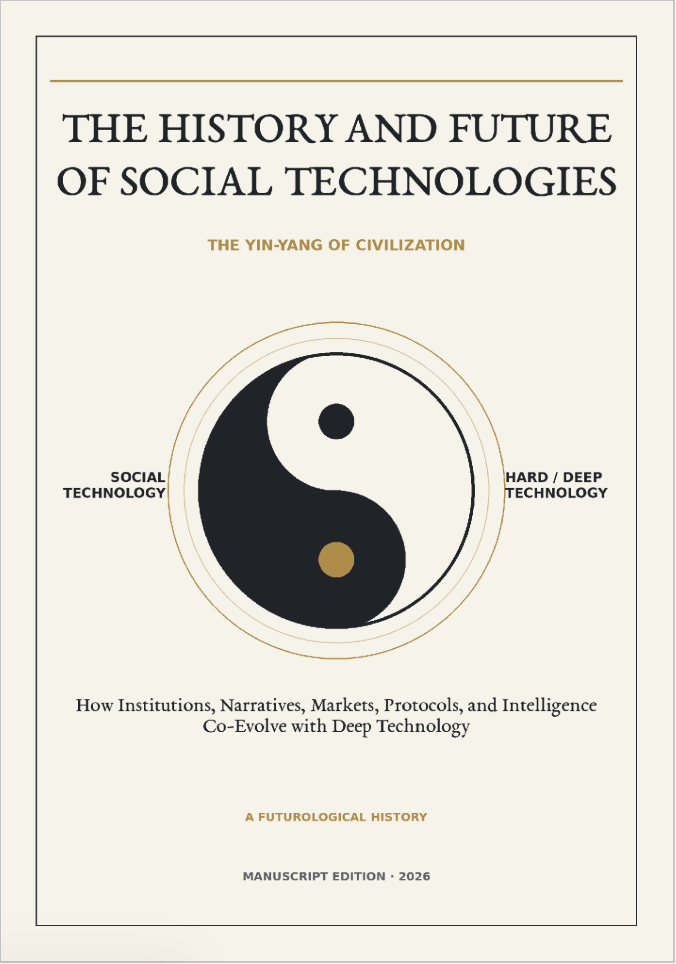
Why do material breakthroughs so often create political crises? The central “yin-yang” argument is that hard technologies expand physical and informational capacity while social technologies allocate authority over that capacity. They develop at different speeds. Industrial production arrived before sanitation and labour protection; digital platforms became planetary before public law caught up. The dangerous interval is institutional lag.
What makes an institution intelligent? Not merely data, automation or central control. The chapters on protocol society and institutional intelligence connect competence to memory, feedback, plural expertise and correction. A system must be able to make decisions, but also to expose error, admit appeal and revise itself without dissolving into permanent paralysis.
What would a future social stack look like? The final chapters move cautiously from history to scenarios: digital identity, AI governance, interoperable protocols and new constitutional arrangements. Their claim is not that a particular platform will rule the future. It is that hybrid civilisation needs institutions designed for machines that can act, learn and coordinate at scale while remaining contestable by people.
Technology changes what can be done; institutions decide who may do it, for whom, and how mistakes can be undone.
The unfinished constitution
This is an interpretive synthesis, not an encyclopedia or a forecast. Its historical chapters move from cooperation before cities through states, political membership, industrial mass society and the internet; its future chapters explicitly treat scenarios as design arguments rather than prophecy. That distinction matters for readers exhausted by both technological inevitability and nostalgic anti-technology.
For people working on AI, public policy, digital identity, platforms or organisations, the book offers language for a fact that technical culture often evades: a solution is never only technical. Its provocation is modest but demanding: capability without legitimacy is unstable, and rights without institutional capacity remain rhetorical. The future depends on learning to build both together.