
Moral anthropology · Axiologic Research Editions
The Thousand-Handed Devil
Complexity, Victims Without Persecutors, and the Future of Responsibility
Enter a world where every official follows the rules, every component passes inspection, and the final result is still cruel. Follow the invisible connections between administrative burden, automated decisions, political resentment, and the leaders who promise one enemy, one answer, and one commanding will.
The victim whose persecutor has dissolved
The book begins from a reversal of the familiar scapegoat story. René Girard’s account makes civilization’s first moral advance the discovery that a crowd’s accusation does not prove its victim guilty. The Thousand-Handed Devil asks what happens when the persecutor is no longer a crowd or king but an opaque mesh of suppliers, dashboards, incentives, legal procedures, automated decisions and dispersed small choices.
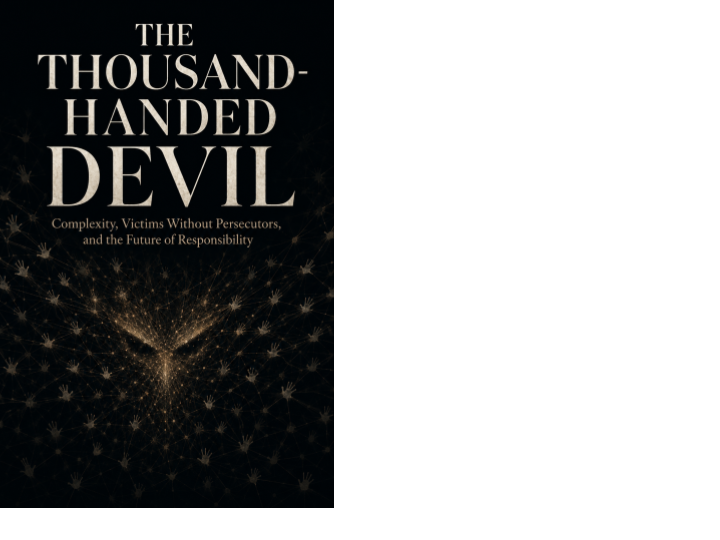
In that world harm remains real, yet responsibility is easy to dissolve. Nobody intended the whole outcome; each participant can cite a narrow mandate; the organisation can point to complexity. The title gives this structure a moral image without turning it into a supernatural explanation. It names a devil with too many hands to hate conveniently, and asks what institutions must learn if the absence of a single villain is not to become the absence of repair.
At the scene, nobody is alone
Can distributed causation excuse anyone? No. The book distinguishes causal complexity from moral emptiness, asking who could have known, interrupted, benefited from opacity or owed repair.
Why is AI a decisive test? It can enlarge the chain between decision and consequence while lending decisions an aura of technical inevitability. It therefore intensifies the need for traceable authority and appeal.
What follows the exposure of a harm? Not a hunt for a symbolic culprit. The book seeks forms of responsibility that preserve local knowledge while making global consequences governable.
Distributed causation must not become distributed innocence.
The name of the thing we built
This compact work refuses to romanticise simple worlds. Complex cooperation feeds cities, treats illness and makes specialised knowledge possible. The unresolved question is how to keep those benefits without allowing bureaucracy and automation to launder accountability. Against the abstractions of algorithmic governance, supply chains and institutional failure, it offers a moral vocabulary with which to ask who could still have acted.