
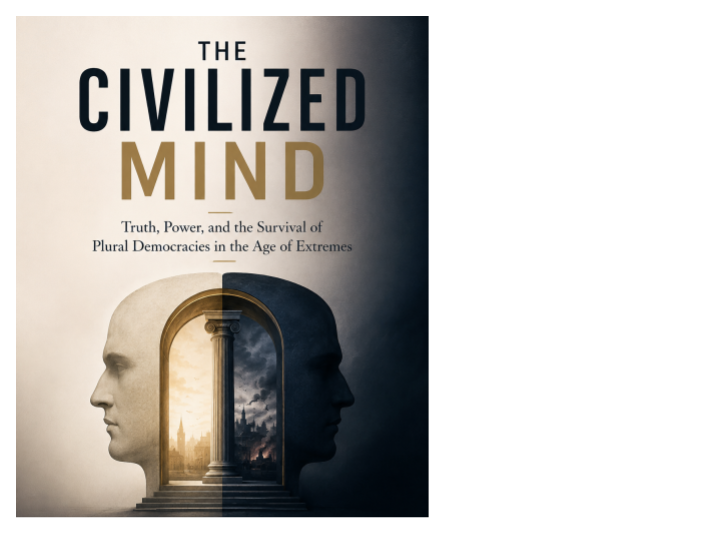
Outfinitist Foundations · Axiologic Research Editions
The Civilized Mind
Truth, Power, and the Survival of Plural Democracies in the Age of Extremes
Enter a demanding conversation about what civilization asks of minds entrusted with unprecedented power. The book invites you to face truths that threaten identity, examine ideals that conceal domination, and imagine institutions strong enough to remain humane, plural, correctable, and free.
The capacity to hold a difficult table
This large book collects what began as separate inquiries, truth that can be received, forbidden subjects, cultural conflict, institutions, biology, technology and democratic survival, because they all press on one question: can people gain power faster than they gain the maturity to use it? Its answer is not a political programme. It is a discipline of mind that treats partial truths as especially dangerous when fanatics monopolise them.
The Civilized Mind refuses the comfort of a single camp. It challenges markets and states, religion and secularism, tradition and technology, elite self-protection and populist resentment. Its “forbidden table” is a practical image for conversation about fertility, migration, identity, inequality, crime, climate, AI and family: topics that do not disappear when decent people avoid them, but are often claimed by those who will use them to divide.
What the table is holding
Can truth be spoken without cruelty? The book treats emotional intelligence as a way to make truth effective, not a device for evasion, and includes scripts for raising painful issues and receiving hard feedback.
Why do facts fail in cultural war? Because status, sacred values, resentment and reputational incentives reorganise what listeners can acknowledge. The response is not to abandon facts but to expose costs and build an off-ramp.
What does plural democracy require? Divided power, honest correction, legitimate competition and the ability to sustain conversation across real disagreement, especially as AI increases social and informational power.
Civilisation is measured not only by what it builds, but by its ability to face its own limits honestly.
The long work of not becoming barbaric
This is the most expansive entry point into the author’s public philosophy. Its length is earned by its ambition: it connects private conversations, family loyalties, public taboos, institutional legitimacy and emerging technology. Readers will not find confirmation without friction. They will find an effort to make disagreement more precise and less dehumanising, with practical attention to how a conversation survives when content and tone become entangled.