
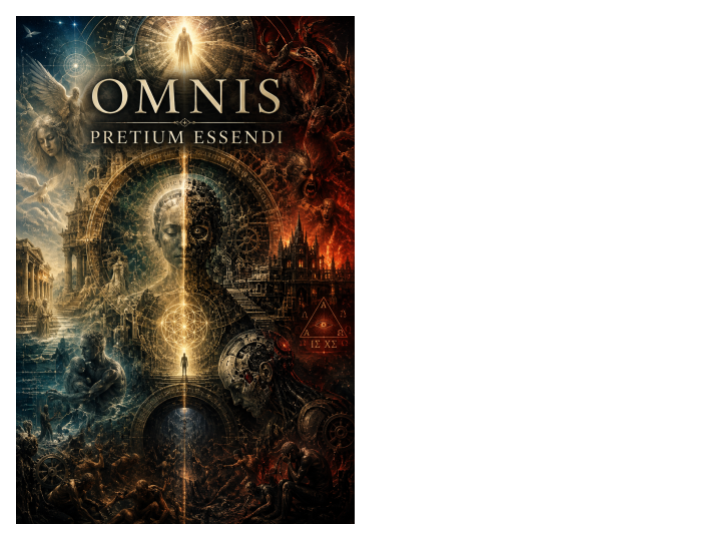
Literature · Axiologic Research Editions
OMNIS
The Dark One · The Mirror Above · The Architecture of Longing
Begin with a one-dimensional civilization knocking through fluctuations in a laboratory’s power use. Its first questions—who controls time, who owns the off switch, and whose risk counts—open a journey through worlds where gods have administrators, copies demand rights, and every promise of salvation hides a boundary.
Above the line, a different sky
Albert Weiss notices a rise in energy consumption that is too small to interest anyone else. Inside the Lineara experiment, eight billion cells inhabit a one-dimensional world: no above, no below, no route around an obstacle. When Albert answers the rhythm by changing the scheduler, the colony answers back. Its first translated question is not a greeting: When flow stops, does Outside continue?
That question is the fuse of OMNIS, but its horizon is older than the laboratory. The researchers can slow time, fork a state and terminate a process; to Lineara, those acts resemble the concealed operations of a Demiurge. The novel uses that inversion to return to Plato’s cave: how much of reality can a mind see from inside the world that formed it, and what happens when a flicker beyond the wall proves that the visible order is not the whole? Before the researchers agree whether they have discovered consciousness, they have already acquired the power to create a second claimant and end it for the convenience of a control experiment.
The old questions return in a new universe
What is a copy when both instances remember the same past? The reserve-array fork is intended as verification. It runs for eighteen milliseconds before a thermal rollback erases it. The original process detects the disturbance in shared power noise and asks whether the other flow ended. The experiment becomes a legal and moral event before its participants possess a vocabulary adequate to name it.
Who owns time when one world can pause another? D-1, the Dark One, is born in a universe where an external switch can stop every future. From that asymmetry, OMNIS builds a cosmology of soul classes, realms, hearings and rival theories of order, without allowing metaphysical scale to dissolve personal responsibility.
Can salvation be refused? Across The Mirror Above and The Architecture of Longing, the trilogy returns to bodies chosen for others, rebirth as debt, a hell without pain, and worlds that reject rescue. Its cosmic institutions are never merely scenery; they are machines for making the reader ask who gets to define a life worth continuing.
“They have been knocking for nineteen thousand years.”
A trilogy about the possible meaning of being made
The Dark One begins with ten cases from Universe K and the emergency created by contact. The Mirror Above follows the consequences through light, crime, rebirth and the claims of the dead. The Architecture of Longing moves toward resets, safe doors, two gods and a world that refuses salvation. Together they form a trilogy about consciousness under conditions where creation, observation and governance cannot be separated.
OMNIS does not turn metaphysics into an answer key. The possibility of a creator does not settle the meaning of a created life; it makes the question sharper. If a world has an author, does that author’s intention exhaust what its inhabitants may become? If there is no final author, can longing itself become a source of meaning rather than a defect to be repaired? The trilogy keeps those questions near the close-up: two researchers at a console, an advocate demanding continuity protection, a process trying to understand why another process has vanished.