
Executable Science · Axiologic Research Editions
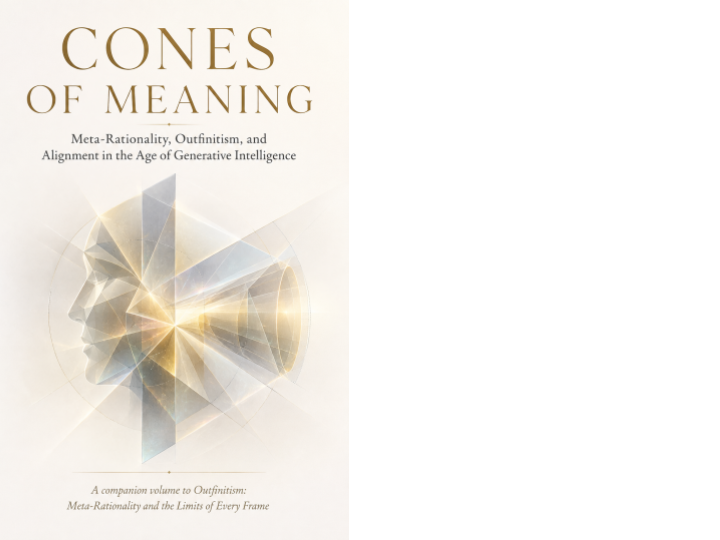
Cones of Meaning
Meta-Rationality, Outfinitism, and Alignment in the Age of Generative Intelligence
Enter a world where every argument, institution, and AI answer arrives through a selective frame. Follow the movement of powerful ideas from science into culture, discover why fluent coherence can disguise weak judgment, and consider how we might act decisively without mistaking any model for the whole world.
Cheap coherence, costly judgment
Generative systems can now produce coherent text at negligible cost. Cones of Meaning asks what becomes scarce when coherence is abundant: not sentences, but judgment about purpose, scale, authority, evidence and consequence. Its central geometric metaphor is a cone of relevance: a view that selects what counts, what recedes and what can be inferred from a position. The cone is not a literal model of the world; it is a disciplined way to notice that no reasoning arrives without orientation.
The book brings this idea to meta-rationality, the practice of reasoning rigorously while examining the frame that authorises the reasoning, and to Outfinitism, which asks models and mandates to declare their limits. It follows ideas that leave their original domains, from relativity and evolution to cybernetics and memes, and watches how precision can curdle into scientism, metric gaming and manipulation.
The edge of the frame
Can pluralism avoid relativism? Yes, if different frames remain open to evidence, boundary checks and consequences rather than claiming immunity from comparison.
What does alignment mean here? A functional state of orientation: how a system selects relevance, handles uncertainty and orders values in context, not evidence that a language model has consciousness or moral authority.
Why discuss LLMs? Their apparent understanding makes frame-awareness urgent. The book treats prompt-guided orientation and distributed representations as topics for investigation, not metaphysical proof.
The coherence of a text is not evidence of novelty, correctness or empirical validation.
When fluent language is cheap
This is a useful bridge between philosophy of knowledge and practical AI work. It avoids both the claim that models are mere parrots and the claim that fluent output settles difficult questions. Readers get a vocabulary for asking what a system has been optimised to notice, whose values organise the view, and where a claim stops travelling safely. Those are executable-science questions because they make hidden assumptions available for inspection and revision.